
Why Rapid Response Matters
Industrial equipment downtime can drain a plant’s profits at an alarming rate—$25,000 to $100,000 per hour, with larger facilities exceeding $500,000 hourly. OSHA mandates a written Emergency Action Plan (EAP) under 29 CFR 1910.38 and 1926.35, requires clear egress, PPE levels defined by HAZWOPER, and annual training. NFPA 1600/1620 and EPA/OSHA process‑safety standards also demand documented hazard assessments, shutdown procedures, and rapid communication. Certified mechanical contractors such as Hutson Industrial Services bring essential capabilities: 24/7 on‑call crews, ASME‑qualified welders, stocked spare‑part inventories, and compliance‑driven repair protocols. Their expertise shortens response time, limits regulatory exposure, and protects the bottom line. By mobilizing qualified teams within minutes, manufacturers can avoid cascading failures, meet audit expectations, and sustain production schedules critical to market competitiveness.
Foundations of Emergency Planning and Compliance
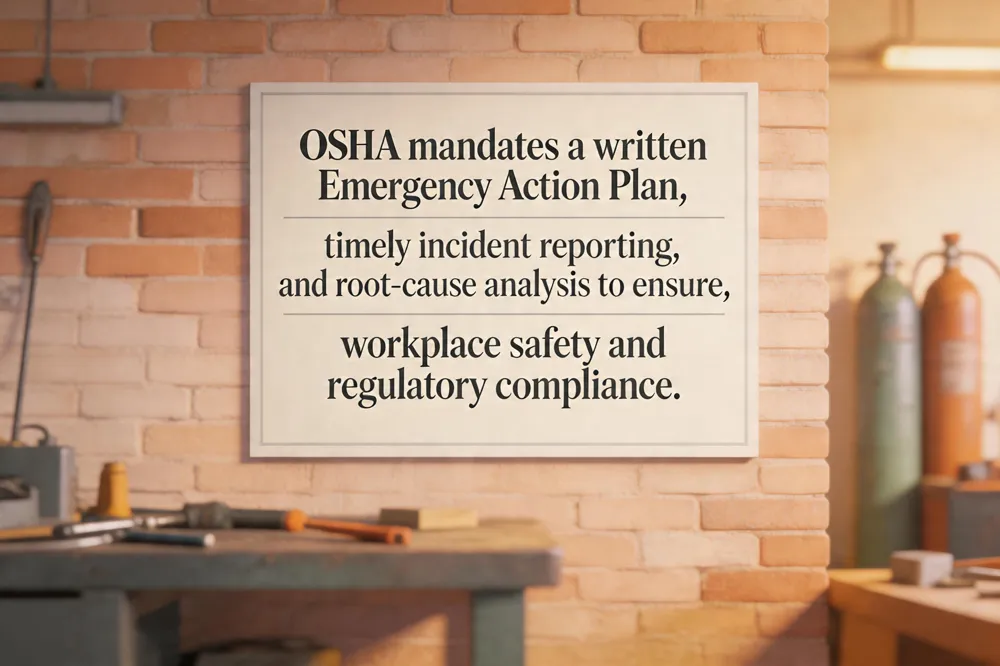
OSHA mandates a written Emergency Action Plan (EAP) under 29 CFR 1910.38/1926.35 that details reporting procedures, marked egress routes, assembly points, shutdown steps and accountability methods. Hazard assessments must precede PPE selection; the HAZWOPER standard (29 CFR 1910.120) defines levels from A (full SCBA) to D (standard work clothing), with Level B/C often required for pressure‑vessel and boiler work. OSHA requires fatalities be reported within 8 hours, in‑patient hospitalizations, amputations or eye losses within 24 hours via the 24‑hour hotline (1‑800‑321‑6742) or the online Injury Tracking Application. Near‑misses—incidents with no injury or damage—must be reported and investigated to uncover hidden hazards. Root‑Cause Analysis (RCA), using tools like the 5 Whys or fishbone diagrams, identifies systemic failures and is required for Process Safety Management events.
OSHA Emergency Action Plan PDF – Download the free EAP booklet from https://www.osha.gov/publications/osha3088.
OSHA Incident Reporting – Report fatalities within 8 hours, other recordable injuries within 24 hours; retain Forms 300/300A/301 for five years.
OSHA Near Miss – Treat near‑misses as warning signs; encourage reporting without blame to correct unsafe conditions.
Root Cause Analysis (OSHA) – Conduct RCA to find underlying causes and implement corrective actions, preventing recurrence and downtime.
Rapid Response Resources and Equipment Readiness
Pre‑positioned Spare Parts and Inventory
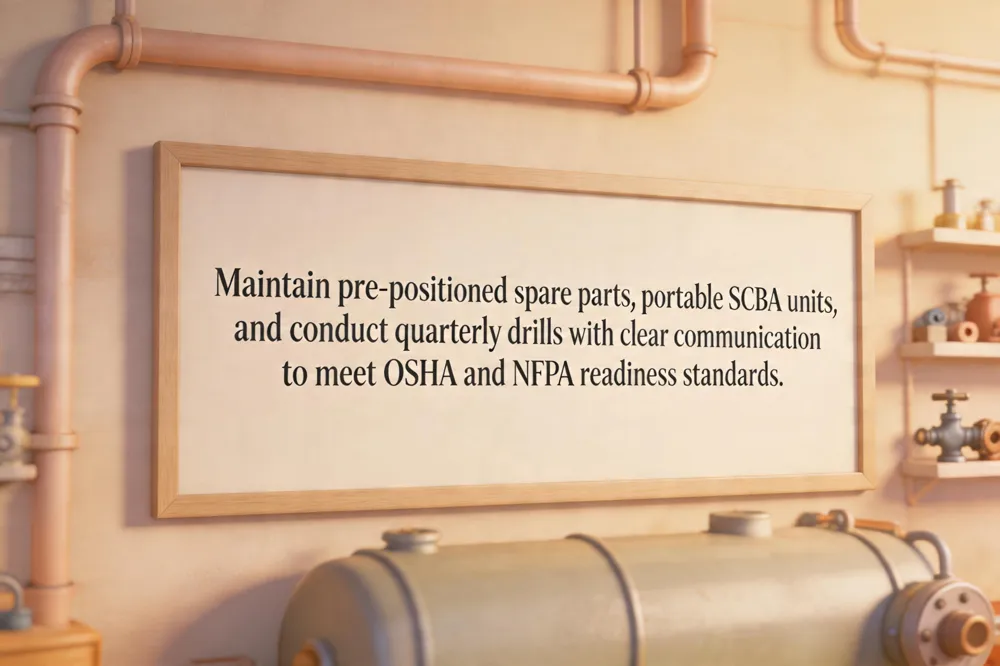
Maintain a stocked inventory of critical spare parts—boiler tubes, safety valves, pump seals—managed through a CMMS. This reduces lead‑time, keeps downtime under 30 minutes, and aligns with OSHA’s hazard‑assessment requirements.
Portable SCBA, Fire Extinguishers, Spill‑Control Kits
Equip crews with SCBA units (Level A/B for chemical/thermal hazards), readily accessible fire extinguishers, and spill‑control kits (absorbent booms, pads). Hutson Industrial Services’ rental fleet ensures immediate availability of these items on‑site.
Drill Frequency and Emergency Communication
Conduct quarterly emergency‑management drills, using PA systems, mobile alerts, and visual/tactile signals to meet OSHA and NFPA standards. Post‑drill “hot‑wash” reviews capture lessons learned.
Five Ways to Respond to an Emergency Situation
- Contact emergency services (911 or on‑site number).
- Secure yourself and others in a safe area.
- Gather location, nature, and hazard data.
- Assist first responders with clear paths and information.
- Do not perform rescues unless trained.
Emergency Preparedness Plan Template
Start with facility name, date, and emergency personnel list (phone numbers). Include evacuation routes, marked exits, fire‑extinguisher locations, assembly points, and a table of emergency contacts. Add reporting steps for medical, fire, severe weather, spill, and power‑loss events, plus a schedule for training and annual review.
Emergency Preparedness Plan for Hospital
All‑hazard plan covering hazard identification, backup power, pressure‑vessel/boiler inspections, communication protocols, staff role training, and coordination with health‑care coalitions. Integrate certified welding and equipment‑rental services for infrastructure resilience.
Emergency Preparedness Plan for Daycare
Site‑specific written plan with evacuation routes, shelter‑in‑place locations, quarterly drills, parent contact lists, child‑accountability procedures, and stocked first‑aid/communication kits.
How Often Should Facilities Practice Emergency Management Plan Drills and Exercises?
Quarterly (four times per year) to maintain familiarity, test equipment, and incorporate updates.
Business Emergency Preparedness Plan
Risk assessment for Indiana hazards, written response plan with communication protocols, evacuation routes, off‑site meeting point, emergency‑kit inventory, protected records, regular staff training, and off‑site plan copies.
Mechanical Contractor Landscape and Market Insights
Regional service providers in the Midwest and Central Indiana include Hutson Industrial Services, a full‑service contractor offering certified welding, pressure‑vessel repair, boiler maintenance and equipment rental. In Florida, firms such as Anchor Mechanical, Inc., Coastal Mechanical Services (Tampa), and large‑scale players like Energy Air dominate commercial HVAC, plumbing and industrial projects.
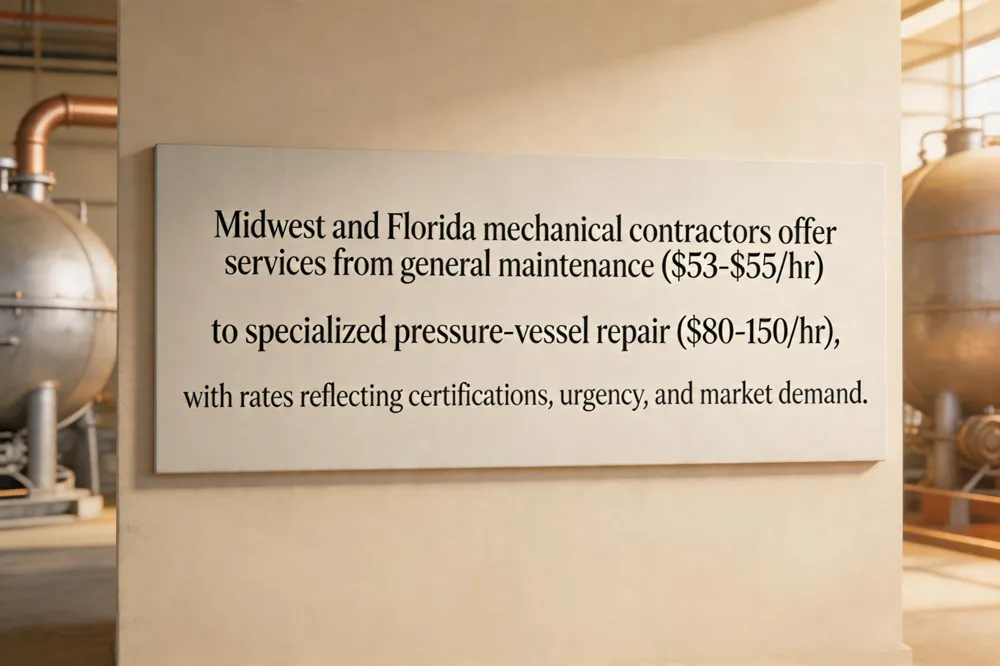
Pricing structures vary by market and expertise. General mechanical work typically runs $53‑$55 per hour, while specialized services—certified welding, pressure‑vessel repair, boiler work—command $80‑$120 per hour. Larger, fully‑qualified contractors in the Midwest often bill $100‑$150 per hour, with high‑risk, highly regulated tasks exceeding $130 per hour. Rates differ for on‑site versus shop work and reflect certifications, insurance and urgency.
Specialized capabilities are essential for industrial failures. Pressure‑vessel repair requires ASME‑qualified welders, HAZWOPER PPE (Level B/C), and rapid shutdown procedures. Boiler maintenance improves efficiency by 5‑15 % and reduces rupture risk. Certified equipment rental supplies portable SCBA units, fire extinguishers and spill‑control kits for immediate response.
How much do mechanical contractors charge per hour? Mechanical contractors typically charge between $50 and $150 per hour, with the exact rate depending on location, the complexity of the job, and the specific expertise required. In the United States, hourly rates for general mechanical work hover around $53 to $55 in many markets, while specialized services such as certified welding or pressure‑vessel repair often command $80 to $120 per hour. Larger firms or those offering comprehensive industrial‑mechanical solutions can charge upwards of $130 per hour for high‑risk or highly regulated tasks. Rates also fluctuate based on whether the work is performed on‑site versus in a shop, and on the contractor’s certifications and insurance coverage. Ultimately, most clients see a range of $100 to $150 per hour for fully‑qualified mechanical contractors in the Midwest and Central Indiana area.
Mechanical Contractor Near Me If you’re searching for a reliable mechanical contractor near you, Hutson Industrial Services in Indianapolis, Indiana is the local solution. We specialize in certified welding, pressure‑vessel repair, boiler maintenance, equipment rental, and comprehensive industrial mechanical services for a wide range of industries across Central Indiana and the Midwest. Our fully licensed and insured team delivers fast, high‑quality work backed by decades of experience and a commitment to safety and customer satisfaction. Whether you need routine maintenance, emergency repairs, or custom engineering solutions, we’re just a call away. Contact us today to schedule a free consultation and discover why businesses throughout the region trust Hutson as their go‑to mechanical contractor.
Mechanical Contractors Miami Mechanical contractors in Miami specialize in HVAC design, installation, repair, and maintenance for both residential and commercial projects, with companies such as Miami Mechanical Inc. and VMECH Mechanical offering 24‑hour emergency service, new‑construction system design, and energy‑efficient retrofits. These firms are licensed, insured, and often hold certifications for government and large‑scale commercial work, ensuring compliance with local codes and safety standards. Many also provide complementary services like duct cleaning, air‑distribution testing, and BIM‑enabled engineering for complex builds. When selecting a Miami contractor, look for clear pricing, responsive communication, and a track record of reliable project completion.
Mechanical Contractors Orlando In Orlando, Florida, there are several reputable mechanical contractors that provide HVAC, plumbing, and industrial services. Companies such as Omega Mechanical Group, SGM Engineering Inc., and Delta Sigma Controls LLC are BBB‑accredited with A+ ratings and serve the Orlando metro area. All Pro Cooling & Heating, LLC and Advanced Refrigeration & Air Inc. also offer commercial HVAC and refrigeration solutions throughout Central Florida. For larger construction‑integrated mechanical work, Ferran Mechanical & Construction and Coastal Mechanical Services provide comprehensive design, installation, and maintenance services for commercial and industrial projects. These firms together cover a broad range of mechanical needs from equipment rental and pressure‑vessel repair to full‑scale building systems.
Anchor Mechanical, Inc. Florida Anchor Mechanical, Inc. maintains a Florida office that serves the entire Sunshine State, with its main contact number (312) 492‑6994 and email info@anchormechanical.com. The Florida location offers a full suite of mechanical services, including HVAC installation, maintenance, and repairs; process piping design and testing; plumbing, boiler, chiller, and refrigeration solutions; as well as electrical, building‑automation, and energy‑efficiency consulting. Their team is equipped to handle projects in major cities such as Miami, Orlando, Tampa, Jacksonville, and St. Petersburg, providing 24/7 emergency support when needed. Anchor Mechanical emphasizes modern, technology‑driven approaches to retrofitting and optimizing building systems for both commercial and industrial clients.
Coastal Mechanical Services Tampa Coastal Mechanical Services operates a Tampa branch located at 5701 E Hillsborough Ave Ste 1140, Tampa, FL 33610. The Tampa office provides HVAC, piping, and plumbing services for commercial, industrial, and institutional projects throughout Central Florida. It is staffed by licensed contractors (CFC1429466, CMC1250574, CMC035444) and draws on the company’s statewide workforce of roughly 300 skilled tradespeople. The Tampa location benefits from Coastal’s 27‑year history, $94.5 million annual revenue, and its reputation for safety‑focused, precision‑driven mechanical solutions. For inquiries, call (813) 764‑8105 or visit the company’s website.
Largest Mechanical Contractors in Florida Florida’s mechanical‑contracting market is led by a handful of firms that dominate commercial projects across the state. The top companies in the North and Central region include Ghost Mechanical (Ormond Beach), Pipeline Mechanical, Inc. (Mount Dora), G6 Mechanical (Winter Park), Tappouni Mechanical Services, Inc. (Tampa) and SouthLand Mechanical, Inc. (Orlando). On a statewide scale, Energy Air is recognized as one of the largest specialty mechanical contractors, ranking 12th in Florida and 4th in the Southeast according to ENR’s specialty‑contractor survey. These firms specialize in HVAC, refrigeration, chiller and cooling‑tower systems, and comprehensive design‑build services for hospitality, healthcare, education and industrial clients. Their extensive experience and capacity make them the go‑to mechanical contractors for the biggest and most complex projects throughout Florida.
Pressure Vessel Safety and Maintenance
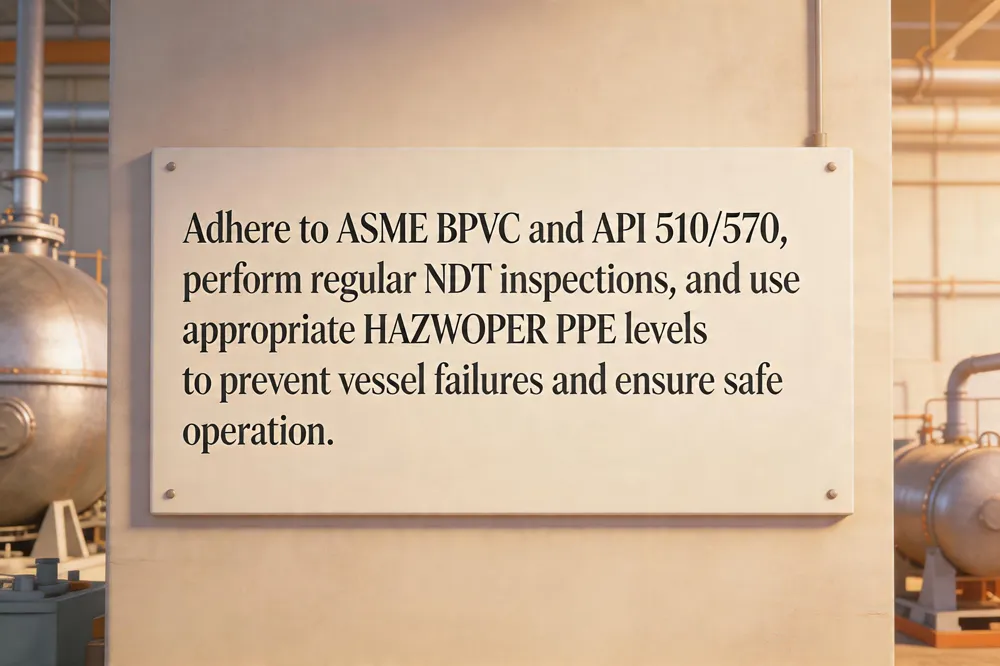
ASME Boiler and Pressure Vessel Code (BPVC) and API 510/570 form the regulatory backbone for design, fabrication, inspection and repair of pressure vessels in the United States. Compliance with ASME Section VIII and API‑approved welding procedures ensures material integrity and proper documentation of each vessel’s history.
Hazard Identification & PPE Levels – Cracked, corroded, or over‑pressurized vessels can release toxic gases, flammable vapors, or high‑energy blasts. OSHA’s HAZWOPER standards dictate PPE from Level C (positive‑pressure respirator plus chemical‑resistant clothing) for chemical‑hazard scenarios to Level B (full facepiece respirator) for thermal or confined‑space threats. All personnel must be trained annually on emergency shutdown, evacuation, and proper donning/doffing of PPE.
Inspection, Testing, & Relief Devices – Routine non‑destructive testing (ultrasonic, radiography), hydrostatic pressure tests, and corrosion monitoring detect defects before failure. Each vessel must have a correctly sized pressure‑relief valve or rupture disk that vents excess pressure to prevent catastrophic rupture. Real‑time pressure and temperature monitoring, combined with alarm‑driven shutdowns, reduces the likelihood of over‑pressurization.
Hazards of Pressure Vessels? Cracks, corrosion, or loss maintenance can cause toxic leaks, fire, explosion, or asphyxiation. Over‑pressurization may discharge flammable substances, creating secondary hazards.
General Safety Provision of a Pressure Vessel? Quality‑controlled design/fabrication, certified relief devices, periodic inspections, and trained personnel with clear signage and records safeguard operation.
What is a Type 4 Pressure Vessel? A composite container with an HDPE liner and carbon‑fiber‑reinforced shell, meeting ISO 11439 for high‑pressure gas storage.
Industrial Accident Investigation Report Documents incident facts, causes, corrective actions, and lessons learned; follows a structured narrative and root‑cause analysis.
Accident Investigation Techniques 5 Whys, fishbone diagrams, fault‑tree analysis, and detailed timeline reconstruction uncover immediate and systemic factors.
Level of Accident Investigation Determined by severity: minor events receive supervisor review, serious incidents trigger low‑ to medium‑level investigations, and fatal or high‑impact events require senior‑management led high‑level analysis.
Career Opportunities, Training, and Services Overview

Industrial Mechanical Contractor Services Jobs
Industrial mechanical contractors hire certified welders, pipefitters, boiler technicians, equipment‑maintenance specialists, project managers, estimators, and field service technicians. Companies such as Hutson Industrial Services also need equipment‑rental coordinators and pressure‑vessel repair experts. Openings are posted frequently, so candidates should showcase certifications, safety training, and hands‑on experience.
Industrial Mechanical Contractor Services Careers
Hutson Industrial Services offers competitive wages, health/retirement benefits, and a safety‑first culture. Apprenticeships, journeyman programs, and continuing‑education partnerships provide on‑the‑job training in welding, pressure‑vessel repair, boiler maintenance, and equipment rental. Clear career ladders and mentorship encourage advancement.
What services do mechanical contractors provide?
They design, install, and service core building systems: HVAC, plumbing, refrigeration, and associated electrical controls. Specialized tasks include pressure‑vessel repair, boiler maintenance, certified welding, and short‑term equipment rental, ensuring code compliance and reliable operation.
Types of MEP Services
Mechanical: HVAC, refrigeration, fire‑suppression pumps. Electrical: lighting, power distribution, emergency backup, fire‑alarm and automation controls. Plumbing: water supply, sanitary drainage, storm‑water, industrial process piping.
$5,000 Rule for HVAC
Multiply equipment age (years) by repair cost; if the product exceeds $5,000, replacement is usually more cost‑effective, especially when downtime, energy use, and spare‑part availability are considered.
Emergency Response Procedures for Shipboard
- Sound the general alarm. 2. Muster crew per procedures. 3. Close watertight doors. 4. Send a distress message. 5. Update vessel position.
Putting It All Together for Resilient Operations
Effective resilience hinges on stitching together an emergency action plan, ready‑to‑use equipment, and personnel. Employers must align OSHA‑mandated EAPs, NFPA guidelines, and HAZWOPER PPE levels with on‑site inventories of SCBA units, spill kits, and replacement parts, ensuring that every hazard scenario can be met instantly. Drills reinforce the plan, test communication channels, and reveal gaps that are closed through after‑action reviews and root‑cause analysis. Improvement cycles turn lessons learned into updated procedures, training modules, and inventory adjustments. Partnering with a regional contractor such as Hutson Industrial Services amplifies this capability: their 24/7 on‑call team, certified welders, pressure‑vessel specialists, and stocked rental fleet deliver isolation, repair, and restoration while complying with ASME, OSHA, and API standards. Together, these elements create a loop that minimizes downtime, protects workers, and sustains production continuity.