
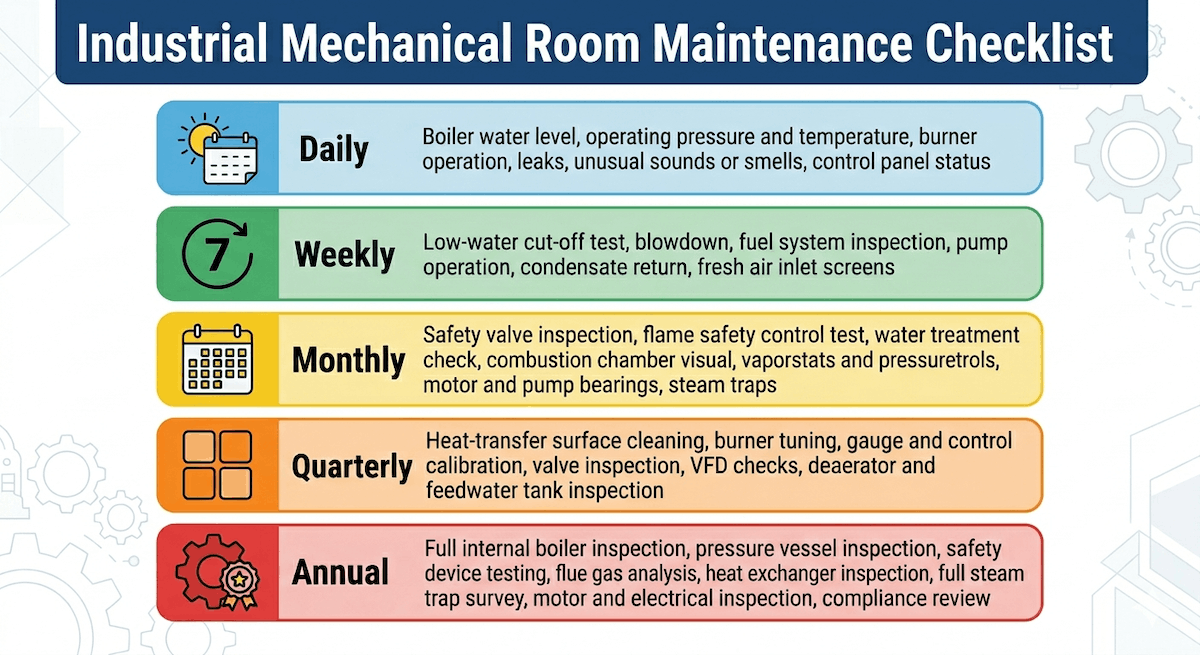
Your mechanical room is one of the most important spaces in your facility. The equipment inside it keeps your building heated, your processes running, and your operations on schedule. But without a consistent maintenance routine, small problems in that room can turn into expensive failures fast.
This checklist is designed for facility managers and plant operators who want a practical guide to what should be inspected, tested, and serviced in an industrial mechanical room and how often each task should happen. If you want a deeper look at the equipment itself, our guide on what’s actually inside an industrial mechanical room is a good starting point.
Daily Checks
Daily checks do not need to be lengthy. The goal is a quick visual and operational review to catch anything that has changed overnight or since the last shift. Train your operators to walk through the following every day:
- Boiler water level: Confirm the gauge glass shows water at the correct operating level. An abnormally low or high reading needs attention immediately.
- Operating pressure and temperature: Verify that both are within normal operating range for your system.
- Burner operation: Confirm the burner is firing properly and that the flame looks normal. Unusual flame color or behavior is a warning sign.
- Leaks: Do a visual scan of piping, valves, and fittings for any signs of water, steam, or fuel leaks.
- Unusual sounds or smells: Knocking, hissing, or the smell of gas or fuel should be reported and investigated before operations continue.
- Control panel status: Check for any fault lights or alarm indicators on the boiler control panel.
Weekly Checks
Weekly tasks go a step further and include basic functional tests that help you catch developing problems before they become failures:
- Low-water cut-off test: Test the low-water cut-off device to confirm it shuts the burner down when water drops below the safe level.
- Blowdown: Perform a blowdown on the boiler and any float-type low-water cut-offs to remove sediment and keep them functioning correctly.
- Fuel system inspection: Check fuel lines, filters, and connections for any signs of leaks or blockages.
- Pump operation: Confirm that feedwater pumps and system pumps are running smoothly, without unusual noise or vibration.
- Condensate return: Verify that condensate is returning to the system properly and that the condensate tank level looks normal.
- Fresh air inlet screens: Check that combustion air inlets are clear and unobstructed.
Monthly Checks
Monthly maintenance is where you start getting into functional testing of safety devices and closer inspection of components that wear over time:
- Safety valve inspection: Manually lift the safety relief valve briefly to confirm it opens and reseats properly. A valve that leaks after testing or will not open needs to be replaced.
- Flame safety control test: Test the flame safety control to verify it shuts the burner down when the flame signal is interrupted.
- Water treatment check: Test boiler water chemistry including pH, alkalinity, and hardness. Adjust chemical treatment as needed to prevent scale and corrosion.
- Combustion chamber visual: Look for soot buildup, scale, or any signs of hot spots on the heat-transfer surfaces.
- Vaporstats and pressuretrols: Confirm these controls are cycling the burner on and off at the correct pressure settings.
- Motor and pump bearings: Listen and feel for unusual vibration or heat in motor housings and pump bearings.
- Steam traps: Do a basic check on accessible steam traps for signs of failure, either passing live steam or blocking condensate drainage.
Quarterly Checks
Quarterly inspections go deeper into the components that affect long-term efficiency and reliability:
- Heat-transfer surface cleaning: Clean the fireside of the boiler to remove soot and scale that reduce heat transfer efficiency.
- Burner tuning: Have a technician perform a combustion analysis and tune the burner air-to-fuel ratio for optimal efficiency. Our team handles industrial burner services including combustion tuning.
- Gauge and control calibration: Verify that pressure gauges, temperature sensors, and control setpoints are accurate.
- Valve inspection: Inspect actuated, solenoid, and control valves for proper operation and any signs of leakage past the seat.
- Variable frequency drives (VFDs): Check VFD operation on pumps and fans and confirm settings match current load requirements.
- Deaerator and feedwater tank inspection: Check for proper operating temperature, pressure, and any signs of corrosion or leaks.
Annual Service
An annual professional service is not optional for industrial boiler and mechanical room equipment. This is where a qualified technician goes through the entire system in detail:
- Full internal boiler inspection: Internal inspection of the pressure vessel for corrosion, pitting, scale, and cracking.
- Pressure vessel inspection: All pressure vessels including tanks should be inspected for compliance with ASME and state requirements. Hutson performs pressure vessel repair and inspection across all vessel types.
- Safety device testing: Full functional testing of all safety valves, low-water cut-offs, high-limit controls, and flame safety controls.
- Flue gas analysis: A full combustion analysis to check for incomplete combustion, excess air, and stack temperature.
- Heat exchanger inspection: Inspect for fouling, leaks between fluid circuits, and signs of corrosion or erosion.
- Full steam trap survey: A comprehensive check of all steam traps in the system, including ultrasonic testing on traps that cannot be visually assessed.
- Motor and electrical inspection: Check motor windings, connections, and insulation resistance on all mechanical room motors.
- Compliance review: Confirm the system meets ASME, OSHA, and local jurisdiction requirements and that all required documentation is current.
A Few Things Facility Managers Often Overlook
Beyond the scheduled tasks above, there are a few areas that tend to get missed until something goes wrong:
- Maintenance records: Every inspection, test, and repair should be logged with the date, technician, and findings. This documentation is critical for compliance audits and for spotting recurring problems.
- Spare parts inventory: Know which components in your mechanical room are most likely to fail and keep OEM-approved replacements on hand. Waiting on parts is one of the biggest drivers of extended downtime.
- Boiler room cleanliness: A clean mechanical room is easier to inspect and less likely to have combustion air issues. Keep the area clear of stored materials and debris.
- Operator training: The people doing daily and weekly checks need to know what normal looks like so they can recognize when something has changed.
How Hutson Industrial Services Can Help
Hutson Industrial Services has been servicing industrial and commercial mechanical rooms since 1978. We provide boiler maintenance programs, annual inspections, pressure vessel service, burner tuning, and emergency repairs for facilities throughout Central Indiana and the Midwest.
If you want help building a maintenance schedule for your facility or need a qualified technician to go through your mechanical room, reach out to our team. We have been doing this work for over 44 years and are glad to help you put a plan in place.