

Introduction
Healthcare facilities in 2026 confront rising construction costs, tighter budgets, and stricter regulatory demands that strain traditional maintenance models. Integrating services, advanced technology, and compliance into a single, data‑driven platform is essential to reduce downtime, improve energy efficiency, and meet ESG goals. Hutson Industrial Services, as a full‑service mechanical contractor, delivers certified welding, pressure‑vessel repair, boiler maintenance, and equipment rental across the Midwest, providing the unified expertise needed to keep hospitals safe, compliant, and operationally resilient.
Comprehensive Maintenance Operations
What does maintenance at a hospital do?
Hospital maintenance teams keep critical infrastructure running by performing routine inspections, preventive servicing, and emergency repairs. They manage HVAC, ventilation, and air‑handling systems to maintain proper temperature, humidity, and air quality in patient rooms, labs, and operating suites. Electrical, plumbing, and mechanical equipment—lighting, generators, medical‑gas lines, refrigeration, and life‑safety devices—are regularly tested, calibrated, and fixed to prevent downtime. Technicians also service specialized medical equipment such as sterilizers, oxygen delivery systems, and hospital beds, ensuring compliance with safety and regulatory standards. Documentation, utility coordination, and staff training support continuous, safe patient care.
What does maintenance mean in a hospital?
In a hospital, maintenance is the systematic inspection, repair, and servicing of the building’s infrastructure, mechanical systems, and medical equipment to keep everything operating safely and efficiently. It includes preventive tasks—HVAC and plumbing checks, elevator upkeep, diagnostic device calibration—and corrective work when failures occur. Maintenance ensures all systems meet health‑safety, cybersecurity, and environmental regulations, extending asset life, reducing unexpected failures, and controlling operating expenses.
Hospital maintenance services Indiana jobs
Indiana hospitals regularly recruit technicians, electricians, HVAC specialists, fire‑system engineers, and equipment repair technicians. Positions are posted on IU Health, University Hospital, Methodist Hospital, Riley Hospital career sites and local staffing agencies. Typical requirements: high‑school diploma or GED, Indiana driver’s license, two‑plus years experience experience experience, and, is. tools; fullMS drawings, is and documentationn, logs.
Hospital maintenance services Indiana pay
Compensation ranges from $40,000‑$70,000 annually for entry‑level technicians, while senior engineers earn $80,000‑$100,000, depending on experience, certifications, and specialty skills.
Regulatory Compliance and Joint Commission Standards
The Joint Commission’s 2026 readiness checklist requires facilities to demonstrate compliance with updated National Performance Goals and the new Physical Environment (PE) chapter. Organizations must provide current safety protocols, equipment calibration records, and verified staff competency, the infection‑control documentation—including high‑consequence disease preparedness, vaccination policies, and cleaning procedures—must be audited regularly. Alignment with CMS Conditions of Participation, covering emergency management, medication‑management policies, and quality‑improvement initiatives, is essential, and a compliance matrix should map each element of performance to supporting evidence.
The 2026 PE standards replace previous Environment of Care and Life Safety requirements, emphasizing building safety, fire protection, reliable emergency power, and systematic equipment maintenance. New mandates include documented procedures for utility disruptions, essential medication refrigeration, expanded security‑risk management, and access‑control policies for sensitive areas.
Food‑service standards demand strict hand‑hygiene, temperature monitoring for hot and cold foods, thorough sanitation of kitchen equipment, allergen management, and life‑safety compliance such as functional fire‑suppression systems.
Telemetry monitoring follows the National Patient Safety Goal to reduce alarm fatigue: equipment must be calibrated, staff trained on alarm settings, and alarm data documented in searchable formats with clear management procedures.
Medication‑management standards (NPSG #14) require a comprehensive program covering prescribing to adverse‑event reporting, automatic‑dispensing cabinet policies, and detailed labeling, all aligned with CMS participation.
The 2026 Joint Commission Standards Manual is available as a downloadable PDF from the Joint Commission website, and the Digital Learning Center offers a subscription‑based library of webinars, videos, e‑books, and policy templates to support ongoing staff education and accreditation preparation.
Strategic Outsourcing and Integrated Facility Management
Integrated Facility Management (IFM) consolidates hard‑service functions—HVAC, plumbing, medical‑gas, boiler, and equipment rental—under a single contract, eliminating fragmented vendor relationships and streamlining data flow. For healthcare providers, IFM delivers a unified CMMS platform that centralizes preventive maintenance, asset tracking, and compliance documentation, enabling predictive analytics that cut unplanned equipment downtime by up to 30 % and extend asset life. The 12‑location coworking network case study illustrates the financial power of this model: by adopting IFM, AI‑driven analytics, and smart‑building sensors, the network reduced operational costs 31 %, lifted member satisfaction 23 %, and achieved a 287 % return on investment within 11 months (source: https://www.spacebring.com/blog/productivity/facility-management-trends-2026). Strategic outsourcing further amplifies these gains by shifting routine maintenance, welding, pressure‑vessel repair, and equipment rental to specialist providers such as HMS Health, Donnelly Mechanical, and Hutson Industrial Services. This reduces vendor‑management overhead, consolidates billing, and frees internal staff to focus on strategic initiatives, ultimately improving cost efficiency and resilience in modern healthcare facilities.
Technology Enablement: Data, AI, IoT, and CMMS
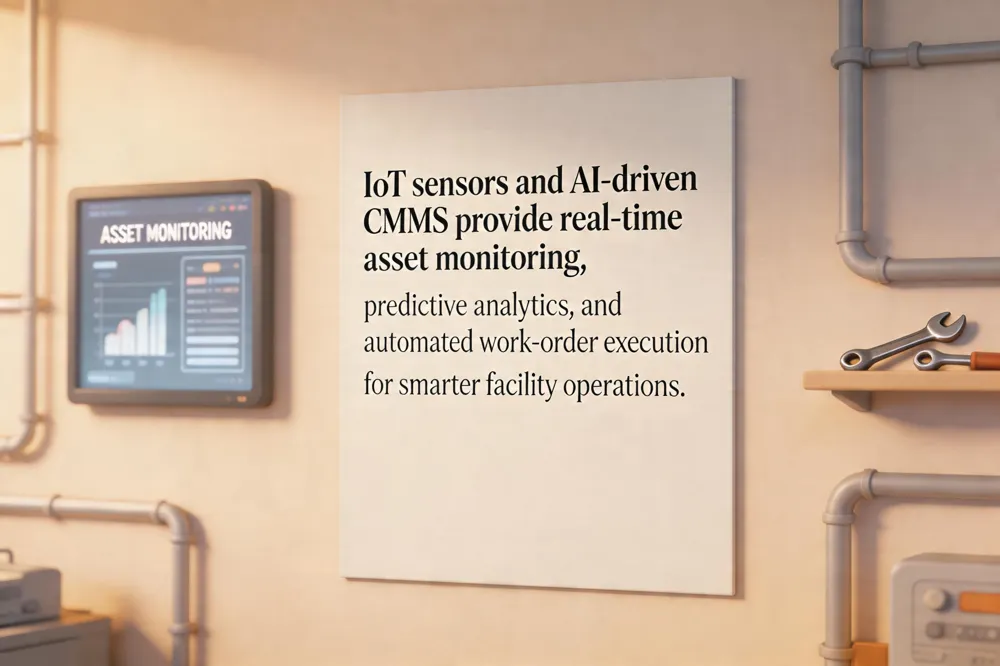
Data‑driven decision making and predictive analytics have become the backbone of 2026 facility management. Real‑time asset monitoring through IoT sensors—temperature, humidity, air‑quality, and equipment health—feeds a unified CMMS that centralizes preventive maintenance, asset tracking, and vendor performance. [AI]‑powered work‑order automation now creates, prioritizes, and schedules tasks automatically, freeing staff for strategic work and cutting maintenance expenses. Predictive analytics detect early‑failure patterns, reducing unplanned downtime by up to 30 % and extending asset life, as shown in ASHRAE and CDC studies. Modern CMMS platforms act as the single source of truth, integrating data from BIM, building automation systems, and mobile apps, while providing dashboards that support ESG reporting and capital‑planning decisions.
What are the trends for facility management in 2026?
Facilities are shifting to data‑centric operations, leveraging AI, IoT sensors, and cloud‑based CMMS for real‑time monitoring, predictive maintenance, and energy efficiency. Portfolio right‑sizing, hybrid‑work space optimization, and workforce upskilling in analytics are also prominent trends.
What are the 5 pillars of facility management?
- Goal‑setting aligned with organizational objectives.
- Comprehensive condition assessments.
- Proactive preventive maintenance programs.
- Effective communication and collaboration among staff, occupants, and vendors.
- Technology enablement—CMMS, IoT sensors, and analytics—to drive data‑driven decisions.
Workforce Development and Industrial Engineering Impact
Industrial engineers are becoming the linchpin of modern healthcare operations. By applying data analytics, lean‑Six‑Sigma, and stochastic modeling, they design and optimize systems that integrate people, equipment, information, and materials. This results in smoother patient flow, reduced wait times, and more efficient surgical scheduling, while also improving supply‑chain logistics and equipment utilization across hospitals and clinics. Their human‑factors expertise creates safer work environments, boosting staff satisfaction and protecting against injury.
Career mobility and continuous training are essential for facilities staff navigating today’s complex environment. A single‑platform management approach—consolidating the Capital Management Plan and CMMS into two sources of truth—facilitates collaboration between Planning, Design, Construction, and Operations teams, reducing data silos and enabling staff to move vertically and horizontally across functions. Standardized user interfaces and competency‑based training empower technicians to transition into strategic roles, supporting retention amid a competitive labor market.
Labor shortages in technical trades such as HVAC, welding, and pressure‑vessel repair are addressed through unified procurement, on‑site equipment rental, and partnerships with certified service providers like HMS Health and Donnelly Mechanical. These strategies streamline vendor management, shorten response times, and provide a reliable pool of skilled technicians, mitigating the impact of workforce gaps on patient care and facility uptime.
What can industrial engineers do in healthcare? Industrial engineers in healthcare design and optimize systems that integrate people, equipment, information, and materials to deliver safer, faster, and cheaper care. They use data analytics, lean‑Six‑Sigma tools, and stochastic modeling to streamline patient flow, reduce wait times, and improve surgical scheduling. Their expertise also enhances supply‑chain logistics, inventory management, and equipment utilization across hospitals and clinics. By applying human‑factors engineering, they create work environments that protect staff safety and increase job satisfaction. Ultimately, they help healthcare organizations achieve higher quality outcomes while controlling costs.
What are essential services in a hospital? Essential hospital services encompass emergency care that provides immediate treatment for acute injuries and illnesses. They also include inpatient and outpatient medical and surgical care, allowing patients to receive diagnoses, procedures, and follow‑up treatment in a coordinated setting. Diagnostic imaging, laboratory testing, and pharmacy services are critical for accurate diagnosis, monitoring, and medication management. Critical‑care units deliver intensive monitoring and life‑support for patients with severe or complex conditions. Together, these core functions ensure that a hospital can meet the fundamental health needs of the community and support a wide range of clinical specialties.
Conclusion
Effective health‑care operations hinge on seven core services: preventive HVAC and boiler maintenance, certified welding and pressure‑vessel repair, medical‑gas system integrity, equipment rental for surge capacity, indoor‑air‑quality filtration, emergency‑power testing, and comprehensive compliance documentation. Partnering with a full‑service contractor such as Hutson Industrial Services consolidates expertise, reduces vendor‑management overhead, and guarantees rapid, compliant response across all disciplines. Looking ahead, data‑driven predictive maintenance, IoT‑enabled monitoring, and integrated sustainability initiatives will further elevate resilience, cost‑efficiency, and patient safety in facility management today.